

Have you ever spent time along a river and noticed how most rivers change along their course? Oftentimes, rivers display alternating patterns of calm flatwater and turbulent faster moving water.
This pattern is not by accident.
Learning to read the river can help you navigate the channel while paddling, or help you know where to cast your line to catch your next fish.
For most of its course, the West Fork lazily meanders through the landscape. The river is sinuous, with large bends and curves where the water is deep and slow. These areas are known as pools.
Riffles are the opposite of pools. Here, the water is shallow and fast moving. Riffles form when larger rocks gather and accumulate, forcing water to flow over them and creating more turbulent movement.
It’s not just about the water. The creatures that live beneath the water’s surface respond to these physical changes. In riffle areas, stream bugs known as benthic macroinvertebrates cling to the rocks, where as fish typically find refuge in deep pools.
One of the most notable sections that displays the alternating pattern of riffle and pools is from Weston to Jackson’s Mill. This 5.5 mile section float offers an exceptional display of the West Fork’s riffle & pool pattern.
The put-in is near the Trans-Allegheny Lunatic Asylum, just downstream of the Weston Dam. While there is no boat ramp, there is public parking (39.036797, -80.470335). The take-out is at Jackson’s Mill and has a paved concrete boat ramp (39.095907, -80.465556).
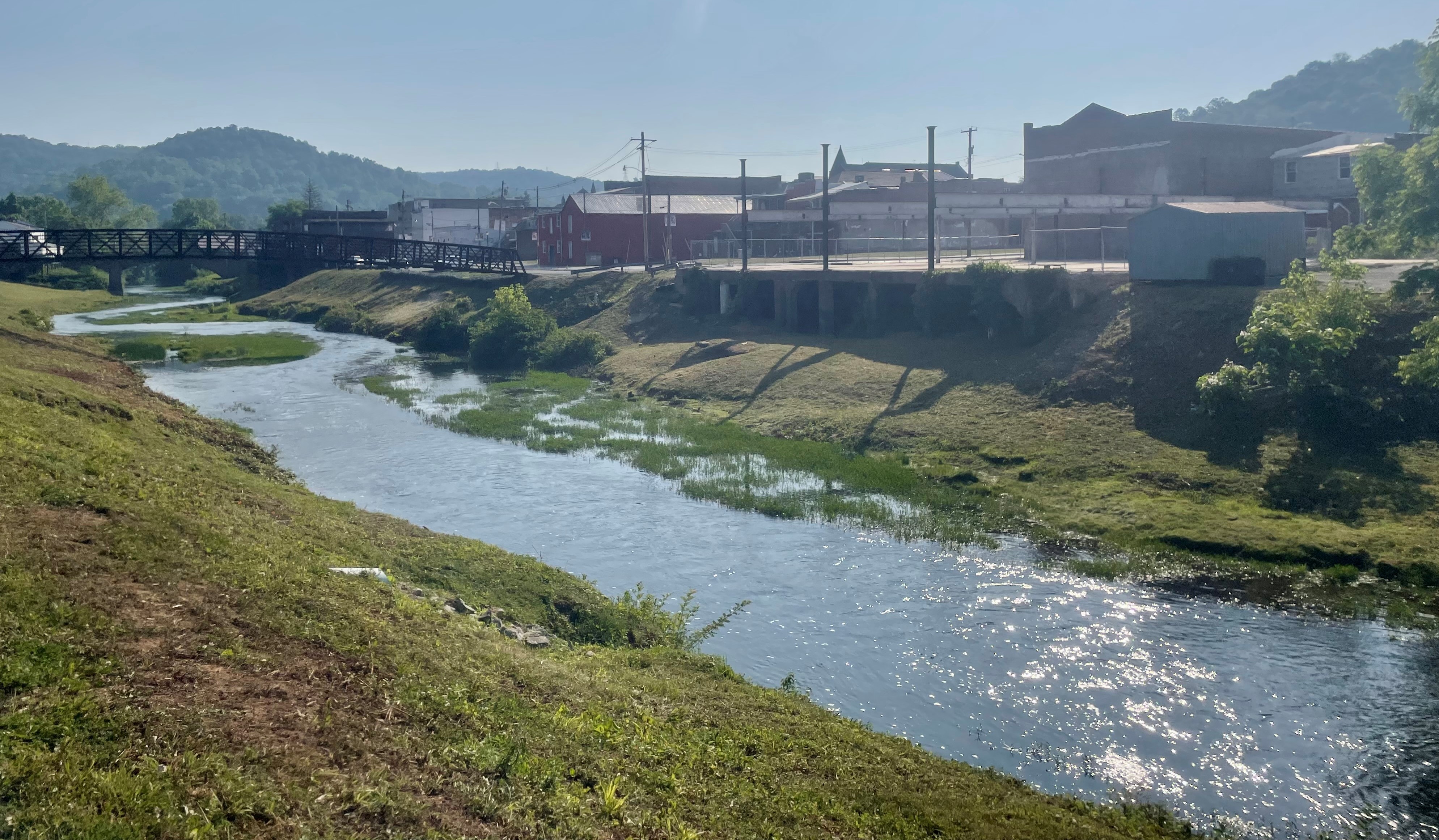
At the put in, the water flows quickly as you float through Weston. After a half mile, the river deepens and slows as you float through a more rural section. Towards the take out, the water picks up speed again as it flows through a riffle section near Jackson’s Mill.
Next time you float on the West Fork, be sure to admire the riffle and pool personality of the river.
By Jessica Bryzek
 Guardians of the West Fork Watershed